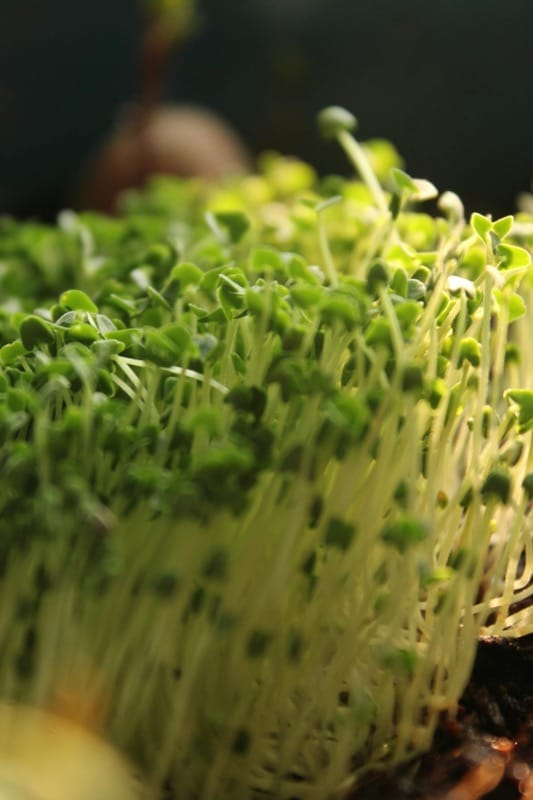
Most home microgreen kits ship with one or two varieties and leave the buyer to figure out what else is worth growing. The honest list is eight. Each works in an Indian kitchen, fits the same 9-inch tray, and produces something edible within two weeks. Some succeed in second orders; some get abandoned. The pattern is consistent enough that we can warn first-time buyers in advance.
- Time: 7-21 days depending on variety
- Yield: 40-120g per 9-inch tray
- Cost: ₹15-₹30 per batch
- The eight varieties below cover almost every Indian kitchen use case
The complaint we hear most often
The same three seed varieties get abandoned in second orders: fenugreek (people expect adult methi taste and get something sweeter), mustard (too spicy for kids, parents stop reordering), and broccoli (slowest of the easy ones, growers run out of patience before harvest). Each for a different reason. The fix is to know what to expect before sowing, which is what this list is for.
1. Radish microgreens (Mooli)
- Harvest: 7 to 9 days.
- Yield per 9-inch tray: around 80 grams.
- Taste: peppery, like a younger radish.
- Why first: fastest to germinate, hardest to fail. New growers should start here. The pink-stemmed shoots are also the most photogenic of the eight, which matters when you are trying to convince a kid or a spouse that the kitchen project is worth doing. If you are picking only one variety for your first tray, radish microgreens is the consistent answer.
2. Mustard microgreens (Sarson)
- Harvest: 8 to 10 days.
- Yield: around 70 grams.
- Taste: sharper than radish, almost wasabi-like in the older leaves.
- Best use: in sandwiches, mixed into bhindi or aloo gobi just before serving. A pinch goes a long way; this is one of the spiciest microgreens on the list.
3. Methi microgreens (Fenugreek)
- Harvest: 10 to 12 days.
- Yield: around 60 grams.
- Taste: exactly like adult methi but sweeter, with the bitterness toned down.
- Best use: chuck into a methi paratha dough, top a moong dal khichdi, or fold into a methi thepla mix. The flavour is familiar enough that most Indian palates accept it immediately.
4. Broccoli microgreens
- Harvest: 9 to 12 days.
- Yield: around 50 grams.
- Taste: nutty, mild.
- The headline: 40 times the sulforaphane of mature broccoli. The one to grow if you are picking microgreens for nutrition over flavour.
5. Sunflower microgreens
- Harvest: 10 to 14 days.
- Yield: around 120 grams, the highest yield in this list.
- Taste: sweet, crunchy, almost like a tender pea shoot.
- Best use: top a salad, throw on a sandwich, add to a grain bowl. Substantial enough to be a real ingredient, not just garnish. The seeds need overnight soaking before sowing.
6. Pea microgreens
- Harvest: 10 to 14 days.
- Yield: around 100 grams.
- Taste: sweet, with twirly tendrils that look beautiful on a plate.
- Best use: stir-fry briefly, eat raw, or use as the green in a sandwich. The same matar from your kitchen works as seed if you soak overnight; specialty pea shoots seeds are not necessary.
7. Basil microgreens
- Harvest: 14 to 21 days, the longest on this list.
- Yield: around 40 grams.
- Taste: intense, fragrant, much stronger than full-grown basil leaves.
- Best use: any dish that wants a hit of basil, especially Italian-leaning ones. Pizza, pasta, caprese-style salads, focaccia toppings.
8. Alfalfa microgreens
- Harvest: 7 to 10 days.
- Yield: around 50 grams.
- Taste: grassy, neutral, makes a salad without dominating it.
- Best use: a classic salad base, the one you grow when you want greens but not strong flavour. Also goes well in sandwiches as a lettuce replacement.
By the end of a month of growing the first four varieties, you have done four batches, eaten about 250 grams of microgreens, and figured out what your kitchen actually wants. Most growers settle on two or three favourites and run them in rotation.
A beginner plan
If you are starting out, do this in order: the complete beginner guide walks through the first cycle in detail:
- Week 1: Radish. Builds confidence; almost impossible to fail.
- Week 2: Mustard. Same shape as radish, very different flavour. Teaches that variety matters more than method.
- Week 3: Methi. Indian comfort food in microgreen form. The first variety that tastes like something from your existing kitchen.
- Week 4: Broccoli. Switch to the nutrient-density variety once you trust the process.
After this, expand based on what you actually used. Most growers settle on radish plus one or two favourites and let basil/alfalfa be occasional adds.
Seeds you do not need to buy specially
The big seeds on this list are just kitchen versions of common ingredients:
- Radish, mustard, methi: kirana grocery store works.
- Pea: standard matar from the kitchen, soaked overnight.
- Sunflower: edible sunflower seeds from a grocery store (not the salted snack kind).
The seeds that need dedicated microgreen-grade sourcing:
- Broccoli, basil, alfalfa: specialty seeds from Amazon, IndiaMART, or AllThatGrows / IndoAg.
Kitchen-grade seeds are often heat-treated and may have lower germination rates than dedicated microgreen seeds. For first-batch experiments, the kirana seeds work fine. For consistent results across many batches, dedicated seeds give better outcomes.
Where each variety wins
- Best looking on a plate: Pea microgreens (tendrils) and radish (pink stems).
- Best for kids: Radish first, then methi. Skip mustard for under-7s.
- Highest yield: Sunflower.
- Best for nutrition: Broccoli.
- Best for Indian fusion dishes: Methi.
- Best for sandwiches and salads: Alfalfa and sunflower.
- Best concentrated flavour for cooking: Basil and mustard.
Where do I buy microgreens seeds in India?
For the bigger seeds (radish, mustard, methi, peas, sunflower), kirana grocery stores work; the kitchen-grade seeds germinate fine for microgreens. For specialty seeds (broccoli, basil, alfalfa), buy from Amazon, IndiaMART, AllThatGrows, IndoAg, or the PotsAlive seed packs.
Can I mix seeds in the same tray?
Yes, but pick seeds with matching harvest days. Radish + mustard works (both 7 to 9 days). Sunflower + basil does not (10 vs 21 days). Mixed harvest dates leave half the tray over-grown by the time the other half is ready.
Which microgreen has the highest nutrient density?
Broccoli, by a wide margin. The sulforaphane content is roughly 40 times that of mature broccoli per gram. Studies on this go back to the early 2000s and have been replicated multiple times.
How many trays should I have running at once for one family?
Two trays staggered three days apart gives continuous harvest. Sow tray 2 on day 3 or 4 of tray 1; harvest tray 1 on day 7; sow tray 1 again. A continuous rotation produces about 80g of fresh microgreens every three to four days.
Why did my methi microgreens taste sweet instead of bitter?
Microgreens of fenugreek lack the bitterness compounds that develop in mature plants. The sweeter flavour is normal; some growers like it more, some less. If you expect adult methi taste, you will be disappointed; if you accept that microgreens are a different ingredient, methi microgreens have their own use.
Eight varieties cover almost every Indian kitchen use case. Start with radish, build to broccoli, expand based on what you actually use. Most growers settle on two or three favourites and let the rest be occasional adds. The eight together are a complete library; you almost never need to look outside this list.