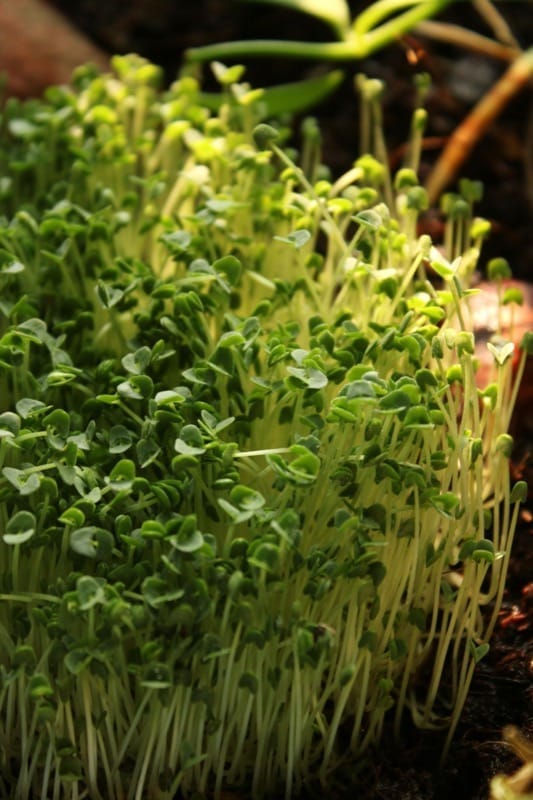
Microgreens are the indoor-growing project with the fastest payoff in Indian kitchens. Seven days from sowing to harvest, almost no equipment, and a flavour and visual appeal most owners do not expect from something they grew themselves. The cycle is short enough to be a weekly routine and forgiving enough to survive most first-time mistakes.
- Time: 7-14 days from sowing to harvest
- Space: a kitchen counter with a window
- Cost: ₹15 to ₹30 per tray after the first setup
- Yield: ~80g per 9-inch tray
What microgreens actually are
Microgreens are baby vegetable plants harvested when they have their first true leaves, usually 7 to 14 days after sowing.
They are not sprouts (eaten with the seed attached, after 2 to 3 days, grown in darkness).
They are not baby greens (grown for 3 to 4 weeks until they reach the small-leaf stage).
Microgreens sit between the two. The first set of cotyledons (round seed leaves) plus the first set of true leaves is the harvest target.
Microgreens pack 40 to 100 times the nutrient density of the adult plant. A handful on a dal is closer in nutritional value to a full serving of cooked greens than most people realise.
What you need
- A shallow tray. Around 2 to 3 cm deep with drainage. Food-grade plastic is fine. The PotsAlive Microgreens Kit ships two trays designed exactly for this.
- Growing medium. One hydrated cocopeat disc fills one tray. We ship cocopeat discs as a single SKU for exactly this use; the disc format is compact, sterile, and consistent batch to batch. Do not use regular potting soil for microgreens; it carries fungal spores that wipe out batches.
- Seeds. Radish, mustard, methi (fenugreek), broccoli, sunflower, peas, basil, alfalfa. Radish is the easiest first variety.
- Spray bottle. Misting is gentler than pouring; pouring dislodges seeds and seedlings.
The seven-day timeline
Day 0 (evening). Soak larger seeds (sunflower, pea, sometimes radish) in water for 6 to 8 hours. Skip this for radish, mustard, methi if you want to sow dry.
Day 1 (morning). Hydrate one cocopeat disc in 500ml of water. Spread an even 1cm layer of the resulting peat across the drainage tray.
Day 1. Drain the soaked seeds. Spread densely across the peat surface. Mist lightly.
Day 1 to 3. Cover with a solid tray to block all light. Mist twice a day.
Day 3 or 4. Uncover when you see white shoots 1 to 2 cm tall. Move to a bright spot with indirect morning light.
Day 4 to 7. Mist daily.
Day 7 to 14 (harvest). Snip with kitchen scissors just above the peat line.
The five mistakes that kill first batches
- Using regular potting soil. It carries pathogens that wipe out the tray. Stick to cocopeat. If you see grey or white fuzzy growth on the surface, check the mold guide to tell root hairs apart from actual mold before discarding a tray.
- Skipping the blackout phase. Light during germination produces leggy weak shoots that fall over. Two to three days in the dark first.
- Watering by pouring. Dislodges seeds, floods the tray, causes uneven germination. Mist only.
- Too much heat. Microgreens grown above 30°C bolt fast and lose flavour. Keep on a shaded counter, not on a sunny windowsill in May.
- Trying to regrow from cut stems. Microgreens do not regrow after harvest. Discard the spent peat and start fresh.
How to use the harvest
Microgreens are kitchen accessories more than meal ingredients. They garnish, they finish, they add texture.
- Toss into salads (handful at a time).
- Sprinkle on dal, curd rice, soup, ramen.
- Garnish a sandwich.
- Blend into chutney with mint and coriander.
- Stir into a raita.
- Top a chaat just before serving.
Eat within three days of harvest. Microgreens lose freshness fast.
Cost per tray
Once the trays are bought, ongoing cost per batch is:
- Cocopeat disc: ₹10 to ₹15
- Seeds: ₹5 to ₹15 (depending on variety, less for radish/mustard, more for broccoli/specialty)
- Water and time: negligible
Per tray cost: about ₹15 to ₹30. A grocery store packet of microgreens at the same yield runs ₹150 to ₹300. The growing-at-home math works out fast.
Why monsoon is the easiest season
Counter-intuitively, monsoon is the easiest time to grow microgreens in India. The high ambient humidity helps germination, the cooler temperatures slow bolting, and the diffuse overcast light is perfect for the green-up phase.
May and June, with peak heat and dry air, are the hardest. The shoots bolt fast, dry out, and turn bitter before harvest. Either move the tray to a cool corner away from windows, or pause microgreens during the worst weeks of summer.
Where to put the tray
- Kitchen counter near a north or east-facing window. Best.
- Covered balcony in monsoon (cooler ambient temperature).
- Bathroom counter with a window. The humidity helps.
- Any shelf or counter with bright indirect light.
Avoid: direct sun (cooks the shoots), air-conditioned dry rooms (dries the peat too fast), interior corners with no light (no green-up after blackout phase).
How much do microgreens cost to grow at home?
About ₹15 to ₹30 per tray when reusing the trays. The cocopeat disc is the largest recurring cost; seeds are minimal for the common varieties. A first-time setup (trays, spray bottle, disc, seeds) runs around ₹300 to ₹600 depending on what you already have.
Can I grow microgreens in monsoon humidity?
Yes, monsoon is one of the easier seasons. Constant ambient humidity helps germination and the cooler temperatures slow bolting. The harder seasons are peak summer (May, June) with dry heat, and very cool dry winters in North India.
Do I need grow lights?
Not for a kitchen-window-sized batch. Indirect bright daylight for six to eight hours is enough. Grow lights matter for production-scale operations or for growing in genuinely dark rooms. For a home kitchen, skip them.
Can I use one tray instead of the two-tray kit?
Yes. Pierce drainage holes in the bottom of a single tray and stand it in a plate or saucer to catch runoff. The two-tray nesting design is more convenient and avoids leaks, but the single-tray-and-saucer setup works for an improvised first batch.
Which microgreen should I grow first?
Radish. Germinates in 36 hours, harvests in seven days, has the highest success rate of any common variety, and the pink-stemmed shoots are visually appealing. Start with radish, then expand to mustard, methi, and pea once you have done one successful cycle.
Microgreens are the one indoor growing project most Indian kitchens can sustain year-round. Seven-day cycle, almost no equipment, low recurring cost, edible result. Start with radish, sow on a kitchen counter near a window, harvest with scissors, eat within three days. The rhythm becomes obvious after the first batch.