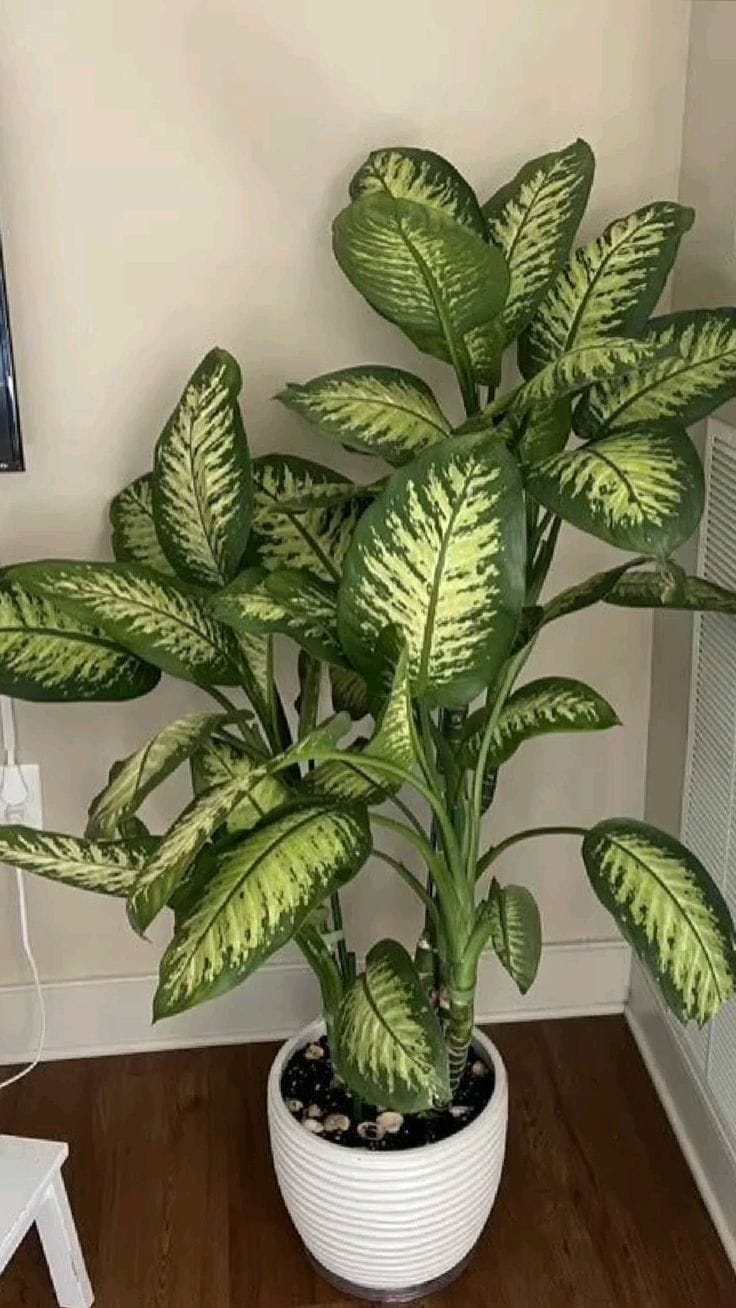
Dieffenbachia, sold in India as dumb cane, is one of the most widely available large indoor foliage plants in Indian nurseries. It tolerates the low-light, dry-air conditions of offices and flats with reasonable grace. It grows large quickly. It does not require complicated care.
The name comes from the effect of its sap on the tongue and throat, calcium oxalate crystals in the plant tissue cause temporary paralysis of the tongue and voice when any part of the plant is chewed or the sap contacts mucous membranes. Keep this in mind, particularly in homes with small children or pets that chew plants.
Why It Works in Indian Offices
Dieffenbachia evolved in tropical forest understories where light is filtered through a dense canopy. This is why it performs acceptably in offices with only fluorescent or LED lighting. It is not thriving in those conditions, it is tolerating them. In truly low light, the new leaves come in smaller, the internodes between leaves elongate as the plant reaches for light, and the overall plant becomes spindly. In good bright indirect light, near a window, dieffenbachia produces large, properly-spaced leaves and grows into a handsome substantial plant.
Varieties
Dieffenbachia seguine and Dieffenbachia maculata are the two species most commonly sold in India, often mislabelled or sold simply as "dieffenbachia." Tropic Snow has large leaves with heavy white patterning and is the most commonly seen version. Camille is more compact with predominantly cream leaves edged in green.
Light
Bright indirect light for the most robust growth. Tolerates moderate indirect light for extended periods. Will not tolerate complete darkness or purely artificial fluorescent light indefinitely. Rotate the plant every two weeks so all sides receive light and the plant grows evenly rather than leaning toward the light source. Direct sun burns the large thin leaves.
Water
Water when the top inch or two of soil is dry. Dieffenbachia does not like to sit in waterlogged soil, it is susceptible to root rot in poor-draining conditions. In well-draining soil in a bright position, watering once a week in summer and every ten to fourteen days in winter is a reasonable rhythm.
Pruning and Shape
Dieffenbachia naturally loses its lower leaves as it grows upward, becoming a cane-like plant with a bare stem at the bottom and a tuft of leaves at the top. When the plant becomes too tall and leggy, cut the main cane back to 15 to 20 centimetres above the soil. The cut cane will push new growth from dormant buds. The section you cut off can be laid horizontally on moist soil in a separate pot, sections of the stem will root and push up new plants.
Toxicity
All parts of the plant are toxic. The sap contains calcium oxalate crystals that cause burning and swelling of the mouth, tongue, and throat if chewed, and skin irritation on contact. Wear gloves when pruning. Wash hands after handling. Keep away from children and pets.
Common Problems
Yellow lower leaves falling off: Some yellowing of the very lowest oldest leaves is normal. If many leaves are yellowing simultaneously, check watering.
Brown leaf tips and edges: Dry air or fluoride in tap water.
Pale new leaves coming in small: Insufficient light or needs feeding.
Stem rot at the base: Root rot from overwatering. Act quickly, remove the affected section, allow to dry, repot in fresh draining mix.
Frequently Asked Questions
Is dieffenbachia safe for homes with cats?
No. It is toxic to cats, dogs, and humans. If a cat chews on the plant, contact a vet. For homes with pets that chew plants, choose a non-toxic alternative.
Why is my dieffenbachia leaning heavily to one side?
It is growing toward its light source. Rotate the pot a quarter turn every two weeks to keep it growing evenly upright.
Can dieffenbachia grow in a bathroom?
If the bathroom has a window with reasonable natural light, yes. In a windowless bathroom, it will decline.
How fast does dieffenbachia grow?
In good conditions it is reasonably fast, a new leaf every two to three weeks in summer. In low light it slows significantly.