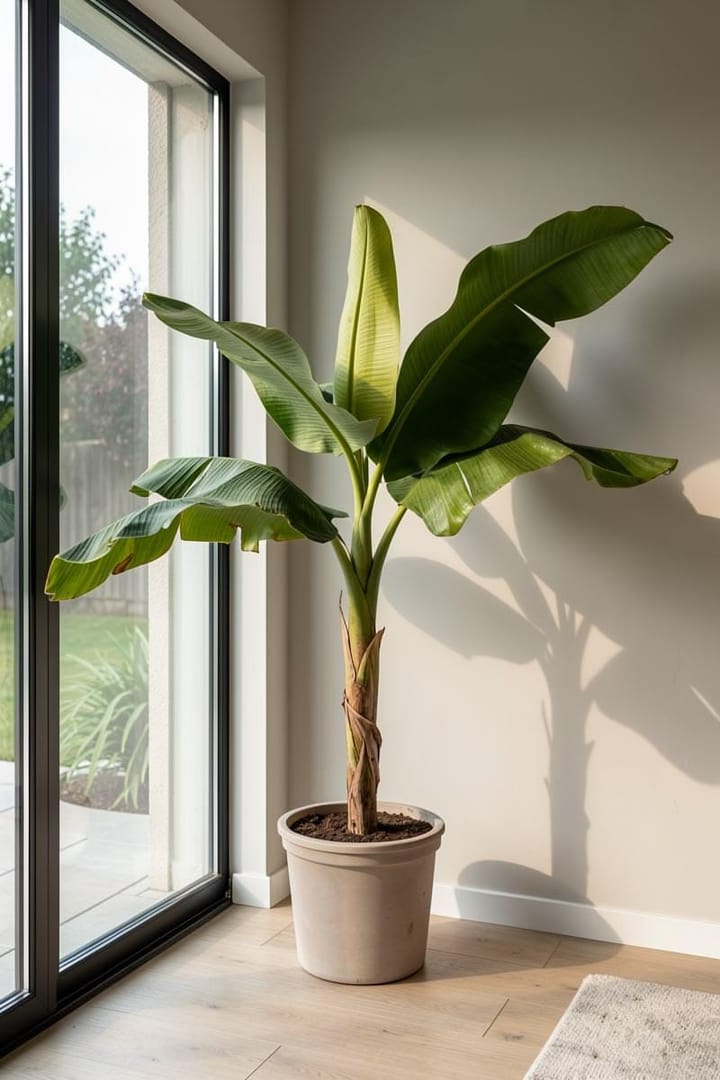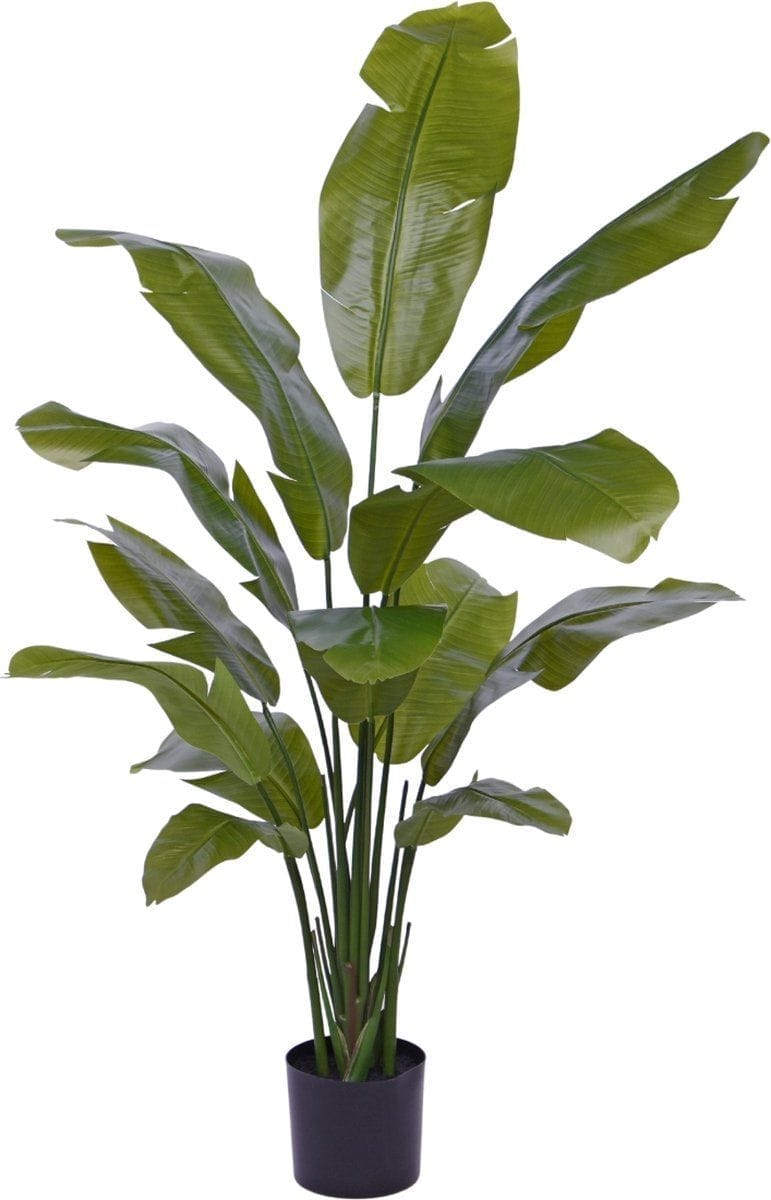
The Travelers Palm (Ravenala Madagascariensis) is the most architecturally dramatic plant most Indian buyers will consider. Long-stalked banana-like leaves arranged in a flat fan, like a giant green peacock tail. In the right space it's spectacular. In the wrong space it's an awkward, leaning, sad version of itself. This is the plant that most rewards an honest pre-purchase conversation about your home's geometry.
Most flats can't host one indoors. The few that can will love it.
It's Not Actually a Palm
The Travelers Palm isn't a palm. It's a relative of Bird of Paradise and the banana family. The shared feature is the long-stalked, paddle-shaped leaves. The unique feature is how the leaves arrange themselves: not in a 360-degree crown like a Bird of Paradise, but in a flat single-plane fan that opens east-to-west.
The traditional story is that the leaf fan aligns roughly along the east-west axis, letting travellers orient themselves. The actual botanical reason is more about light capture, but the story persists because it sounds good and is occasionally accurate.
Ceiling Height and Spread You Need
Travelers Palm is a big plant. An indoor specimen typically reaches:
- Height: 2.5-4 metres indoors, 8-12 metres in tropical gardens.
- Spread: 1.5-2.5 metres wide once the fan is mature.
- Floor space: needs about 2 metres of clear floor space in front of and to the sides of the pot.
Standard Indian flat ceiling height is 2.7-3 metres. A mature Travelers Palm pushes the ceiling. A young one (1.5-2 metres) fits comfortably for the first few years but will need a taller space within a decade.
Spaces where Travelers Palm works indoors:
- Double-height drawing rooms or atria.
- Tall-ceiling foyers in older bungalows.
- Loft-style apartments with 4-metre+ ceilings.
- Indoor courtyards or sunrooms.
- Hotel lobbies, large office receptions, restaurant atriums.
Spaces where it doesn't work:
- Standard 2.7-3 metre ceiling apartments (works for 2-3 years, then outgrows).
- Tight corners or narrow hallways.
- Any room where you can't position the plant with 1.5+ metres of clearance on all sides of the fan.
Light
Travelers Palm wants bright filtered light, ideally with some direct morning or evening sun.
- South or south-east window with sheer curtain: ideal. Strong filtered light most of the day.
- Floor-to-ceiling window in any orientation: works if there's enough room.
- Atrium or skylight: excellent.
- Covered balcony in Bangalore, Mumbai, Kerala: great.
- North window: marginal. Plant survives but slow growth and reduced fan size.
- Interior space with only side daylight: doesn't work long-term.
Water
Travelers Palm is thirsty during active growth and tolerant of monsoon flooding. Indoor specimens want moist soil that drains well.
Stick a finger 2 inches into the soil. Dry? Water. Damp? Wait.
- March–June: every 3-5 days.
- July–September: every 5-8 days.
- October–February: every 8-12 days.
Always water deeply, drain fully, empty the saucer. The thick fleshy roots do rot in standing water despite the plant's wet-tropical origins.
Orientation and the Fan
The Travelers Palm leaf fan grows in one plane. Once a plant has decided which axis to fan along, it stays committed to that axis. Subsequent leaves emerge alternately from either side of the trunk, perpendicular to a fixed orientation.
What this means for placement:
- The fan needs clearance along its plane, not perpendicular to it. A long narrow room can host a Travelers Palm if you align the fan along the long axis of the room.
- The plant won't reorient itself to fit your room. If your fan happens to develop perpendicular to your wall, the leaves will hit the wall on one side.
- If you want to influence the orientation, rotate the pot in the first 6-12 months of the plant's life so the early leaves align with your space. Once mature, the axis is fixed.
Soil Mix
Rich, moisture-retentive, well-draining:
- 40% coco peat (see our coco peat formats guide)
- 30% rich potting soil or compost
- 20% perlite or coarse sand
- 10% well-rotted cow manure
Travelers Palm has a substantial root system. Repot every 2-3 years, going up one pot size. Use a wide stable pot; a top-heavy plant in a narrow pot will topple over.
Feeding
Heavy feeder. A balanced NPK at half strength every 2-3 weeks during March-October. See our NPK guide.
Or two fertilizer sticks per 12-inch pot (this is a large feeder), replaced every 6 weeks during the growing season.
Skip feeding November-February.
Common Problems
1. Shredded Leaves
Like banana plants and Bird of Paradise, Travelers Palm leaves split along the veins. Indoors this is usually from contact with walls, fans, or AC airflow. Mostly cosmetic, not a health problem. If you want intact leaves, you need more clearance around the plant or a more controlled environment.
2. Brown Leaf Edges
Low humidity, tap-water salts, or both. Travelers Palm is sensitive to chlorinated water. Switch to settled water and flush the pot every 2-3 months. Raise local humidity if possible.
3. Leaning Trunk
The fan plane is heavy. If the pot is narrow or the trunk is uneven, the plant leans toward the heavier side. Stake with a thick bamboo cane and soft ties, or repot into a wider, heavier pot.
4. Slow or No New Growth
Either light too low or pot constraint. Travelers Palm grows quickly in the right conditions (a new leaf every 4-6 weeks in summer) and noticeably slower in cramped roots or dim light.
5. Yellow Lower Leaves
Usually normal aging. The oldest leaves yellow and drop as new ones emerge from the centre. Cut the yellowed leaves cleanly at the trunk to keep the fan looking sharp.
Where to Place It at Home
- Double-height living room with a tall window: the natural Travelers Palm spot. The fan reads as a piece of architecture.
- Atrium, sunroom, or indoor courtyard: ideal. Light, height, room to spread.
- Long narrow corridor with daylight at one end: works if the fan can align along the long axis.
- Hotel lobby, large reception, restaurant interior: the commercial setting Travelers Palm was made for.
- Sheltered outdoor courtyard in South India: best of all, year-round.
Avoid:
- Standard apartment ceilings.
- Tight corners.
- Rooms where the fan plane doesn't have clearance on both sides.
- Direct AC airflow on the leaves.
Bottom Line
The Travelers Palm is one of the most dramatic indoor plants you can own in India, but only in a fraction of Indian homes. If you have a tall ceiling and a long sightline, it's spectacular. If you have a standard apartment, choose Bird of Paradise or a large Schefflera instead. Don't fight the geometry; Travelers Palm wants what it wants, and it tells you so by leaning, shredding, and refusing to thrive when it doesn't get it.