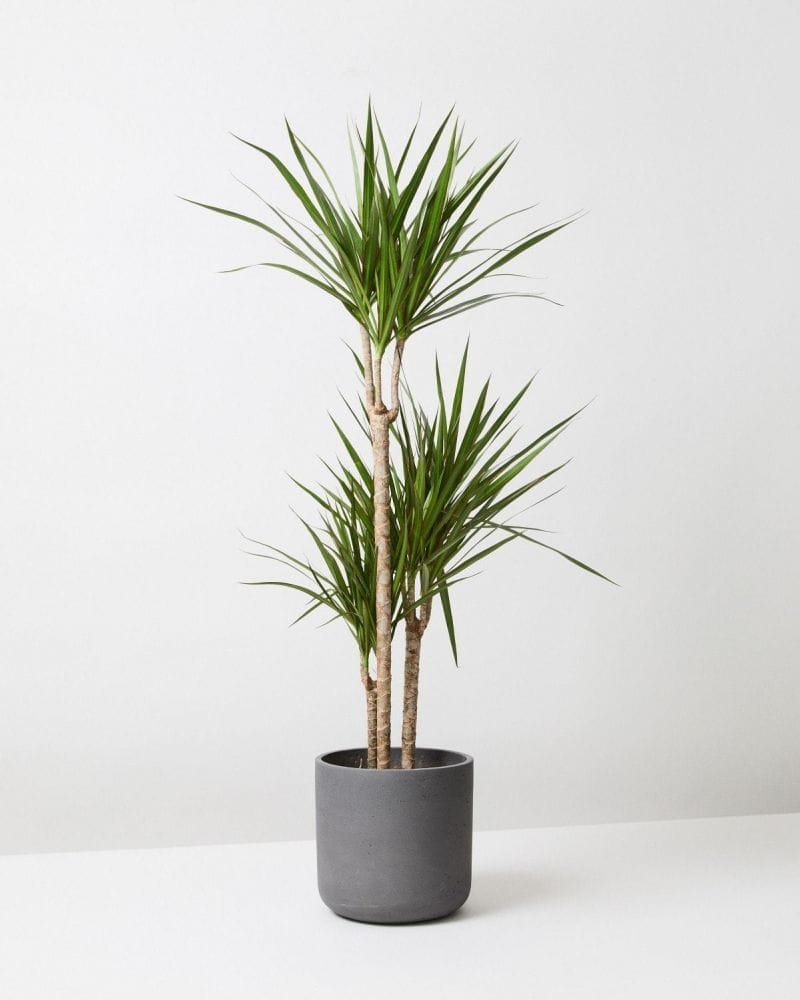
The Dracaena Marginata, or Dragon Tree, is one of those plants that looks like it was designed by an interior architect. Slim woody trunk, sometimes branched, sometimes twisted into a curve, topped with a fountain of narrow spiky leaves. The whole shape reads "intentional" in a way most houseplants don't. It also happens to be cheap, easy, and roughly as low-maintenance as a Snake Plant.
Three varieties show up in Indian nurseries, and the visual difference is significant.
Which Marginata You're Buying
- Plain green Marginata: deep green leaves with a thin red-purple edge. The cheapest, the toughest, and the most light-tolerant.
- Marginata Tricolor: green, cream and pink stripes along each leaf. Slower-growing because the cream patches don't photosynthesise. Needs more light to keep the colouring.
- Marginata Colorama: dominated by pink and red rather than green. The most striking visually, and also the most demanding. Without strong indirect light, the pink fades and the leaves go a sad green.
For a first Dracaena in India, buy plain green or Tricolor. Save Colorama for when you have a bright window and want the showstopper.
The Bare-Trunk-With-Tuft Look
One of the things people love about a Marginata is the eventual look: a tall, almost-bare cane with a tuft of leaves at the top, like a small palm. This happens naturally over time. As the plant grows, old lower leaves yellow and drop. The trunk woody-fies. You're left with the architectural silhouette.
The same process panics new owners, who think the plant is dying every time a lower leaf turns yellow. It isn't. Old leaves dropping at the bottom while new growth keeps emerging at the top is normal Marginata behaviour. The plant is doing what it's supposed to.
Concerning version: multiple leaves turning yellow at once, or leaves dropping from the top growth point. That points to overwatering or shock.
Light
Marginata tolerates a wide light range. Plain green will survive almost anywhere. Variegated forms get fussier.
- Bright indirect light near an east or south window: ideal for any variety. Best for keeping the pink and cream in Tricolor and Colorama.
- Filtered south or west sun: fine. Direct hot afternoon sun in May-June Delhi will pale the leaves but won't kill the plant.
- Lower light, 2+ metres from a window: plain green Marginata copes well. Variegated forms slowly lose their colour.
- Dark corner: plant survives but becomes leggy and weak, with sparse leaves and a thin floppy trunk.
Water
Dragon Trees prefer their soil on the dry side. The cane stores some water, and the root system is finer than it looks. Overwatering is the most common way to kill one.
Stick a finger 2 inches into the soil. Dry? Water. Damp? Wait.
- March–June: every 7-10 days.
- July–September: every 14-18 days. Monsoon air keeps soil damp for ages.
- October–February: every 14-20 days.
Water deeply, let it drain fully, empty the saucer. A Marginata sitting in standing water for a day starts root rot.
The Tap Water Problem (Brown Tips)
This is the diagnostic almost every Marginata owner gets wrong. The leaf tips turn brown and crispy, sometimes spreading a centimetre or two down the leaf. Most people blame "low humidity" and start misting daily, which does nothing.
The real cause, nine times out of ten: fluoride and chlorine in tap water. Dracaenas are unusually sensitive to both. The chemicals accumulate in the leaf tips and burn them from the outside in.
Fix:
- Leave tap water in an open container for 24 hours before using it. Chlorine evaporates; some fluoride settles out.
- Better: use harvested rainwater during monsoon, or RO reject water.
- Once every couple of months, flush the pot heavily. Pour water through until it runs out the drainage hole for a full minute. This rinses accumulated salts.
- Trim the brown tips with sharp scissors. Cut at an angle to mimic the natural leaf shape, just inside the brown edge.
Soil Mix
Standard well-draining mix:
- 35% coco peat (see our coco peat formats guide)
- 30% potting soil or compost
- 25% perlite or coarse sand
- 10% small bark chips
Marginatas don't need frequent repotting. Every 2-3 years is plenty. They actually prefer being slightly root-bound, which is one reason they tolerate neglect so well.
Feeding
Light feeder. A balanced NPK (10-10-10 or 20-20-20) at quarter to half strength every 6-8 weeks during March-October is enough. See our NPK guide for context.
Slow-release fertilizer sticks work well too. One stick per 8-inch pot, replaced every 8 weeks during the growing season.
Stop feeding entirely from November to February. Marginatas barely grow in cool weather and over-feeding in winter just builds up salt in the soil.
Pruning: How to Force a Branched Trunk
A Marginata grown without intervention forms one long bare cane with a tuft at the top. If you want a branched, multi-tufted plant, you have to force it.
Cut the trunk cleanly with a sharp knife at the height where you want branching. Two or three new growth points will emerge from just below the cut within 6-10 weeks. The cut wound heals over and becomes a node in the trunk shape.
The plant looks bad for 2-3 months while it regenerates. Worth it for the long-term shape.
Spring (March-April) is the best pruning time. Cuts heal fastest then. Avoid pruning in winter, when wounds can stay open for weeks.
Common Problems
1. Brown Leaf Tips
Tap water fluoride and chlorine. Switch to settled water, flush the pot every couple of months, accept that you'll need to trim tips occasionally. See the tap water section above.
2. Yellow Lower Leaves
If it's the lowest leaf and one at a time over weeks, that's normal aging. Cut the leaf off cleanly at the trunk.
If multiple leaves yellow at once and the soil feels wet, that's overwatering. Stop watering for 2-3 weeks and check root health.
3. Fading Pink or Cream
Variegated Marginatas (Tricolor, Colorama) need brighter light than plain green. If your colourful Dracaena is going mostly green, the light is too low. Move closer to a window.
4. Floppy Trunk Leaning Over
Either light is too low (plant stretches and weakens) or the rootball has rotted and can no longer support the cane. Check soil moisture. If soil is dry and plant is leaning, move to brighter light. If wet, investigate the roots.
Propagation
Marginatas root from cane cuttings, which is convenient because you usually end up with cuttings after pruning anyway.
- Cut a 15-20 cm length of healthy cane, ideally with a leaf tuft at the top.
- Let the cut ends air-dry for a day so they callus.
- Stick the bottom end in damp coco peat with perlite, or in a glass of clean water.
- Keep warm and in bright indirect light.
- Roots appear in 4-8 weeks. Once they're a few centimetres long, pot up in standard mix.
You can also root the bare middle sections of cane that don't have leaves. Insert them upright in soil. New growth points will emerge from the top end within a couple of months.
Where to Place It at Home
- Living-room corner near an east or south window: the architectural cane fills vertical space without taking up floor area.
- Pair flanking an entrance or media unit: the symmetrical shape works well in matched pairs.
- Open staircase landing: the height suits the vertical space.
- Office reception or co-working corner: tolerates AC and occasional neglect; looks intentional in commercial settings.
Avoid:
- Tight corners where the leaf tuft hits a wall or ceiling.
- Direct AC blast zone (leaf edges crisp).
- Decorative pots without drainage holes.
- Homes with cats or dogs that chew plants.
Bottom Line
The Dracaena Marginata is the indoor plant equivalent of a well-designed lamp. Slim, sculptural, low-effort, easy to position. Plain green is the bulletproof choice; Tricolor and Colorama need brighter light but reward you with colour. The two things to manage are watering frequency (less than you think) and tap water chemistry (settle the water for a day). Get those right and the plant will live for a decade.