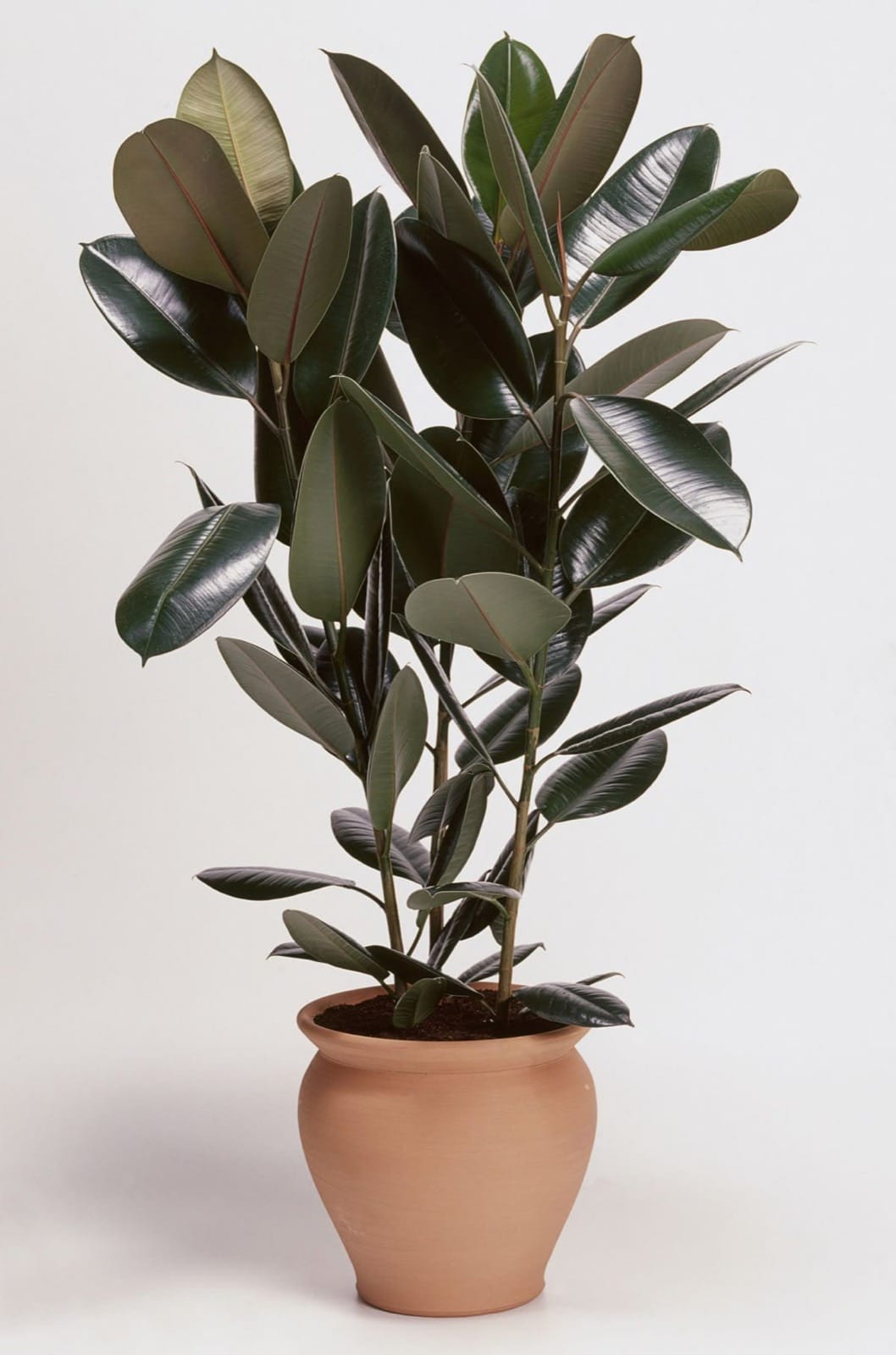
The Rubber Plant, Ficus elastica, is the houseplant we recommend to people who killed a Fiddle Leaf Fig. Same family, similar look, a fraction of the drama. It tolerates Indian heat, Indian winters, occasional missed waterings, and being moved across rooms without throwing a tantrum. If you want a large, glossy, statement plant with a low chance of regret, this is it.
The catch: there are five common varieties sold in India, and the nursery often can't tell you which one you're looking at.
Varieties: What You're Actually Buying
- Ficus elastica Robusta: large, oval, deep green leaves. The "classic" rubber plant. Toughest variety, fastest grower, most forgiving. If a nursery doesn't specify, this is usually what you're getting.
- Ficus elastica Burgundy (or Black Prince): same shape, but the leaves emerge red and mature to a deep burgundy-black. The most photogenic. Slightly slower than Robusta, otherwise identical care.
- Ficus elastica Tineke: green and cream variegation. Slower-growing because the cream patches have no chlorophyll. Needs brighter light than the plain varieties or the variegation fades.
- Ficus elastica Ruby: pink, cream and green variegation. Hard to find, expensive, even more light-hungry than Tineke. Skip unless you have a strong window.
- Ficus elastica Decora: broader leaves than Robusta, similar deep green. Often labelled just "rubber plant" in Indian nurseries.
For a first rubber plant in India, buy Robusta or Burgundy. Tineke if you have a bright window and want the variegation.
Light
Rubber plants want bright, indirect light, but they tolerate a wider range than Fiddle Leaf Figs.
- East or south-east window: ideal. Two to three hours of soft sun, bright shade afterwards.
- South window: fine with a sheer curtain. Direct mid-day sun in May-June can scorch the leaves but won't kill the plant.
- West window: pull back 1-1.5 metres from the glass to avoid hot afternoon sun.
- North window or 2 metres from any window: Robusta and Burgundy will survive happily. Tineke and Ruby will lose variegation and stretch toward the light.
- Dark corner: the plant will live but go leggy: long stems, sparse leaves, weak growth.
Water
Rubber plants prefer their soil on the slightly-dry side. They're closer to a Snake Plant than a Monstera on the watering spectrum.
Stick a finger 2 inches into the soil. Dry? Water. Damp? Wait.
- March–June: every 5-8 days.
- July–September: every 10-14 days. Monsoon is when most rubber plants get overwatered.
- October–February: every 12-16 days. Almost no growth, almost no water.
Water deeply, let drain fully, empty the saucer. Rubber plants tolerate underwatering better than overwatering, a thirsty rubber plant droops dramatically and bounces back within a day, while a rotted one takes weeks to diagnose.
Why the Lower Leaves Drop (It's Normal)
Every rubber plant owner panics about this. Old lower leaves yellow and drop, leaving a bare trunk with a tuft of leaves on top.
This is partially normal. Rubber plants are tropical trees. In nature, they shed lower leaves as the trunk grows. Indoors, the same thing happens, usually a few leaves a year as the plant gains height.
Concerning version: multiple lower leaves yellowing and dropping in a short window (under a month). That's overwatering, root rot, or a recent shock, diagnose with the soil-moisture check and a look at the roots.
If your plant has gone too leggy and you want it bushier, see the air-layering section below.
Soil Mix
Standard well-draining mix:
- 40% coco peat (see our coco peat guide)
- 30% potting soil or compost
- 25% perlite or coarse sand
- 5% well-rotted cow manure
Rubber plants don't need to be repotted often, every 2-3 years is plenty. Go up one pot size only.
Feeding
A balanced NPK (20-20-20) at half strength every 3-4 weeks during March-October. Skip November-February. See our NPK guide for what those numbers mean.
Or use one fertilizer stick per 8-inch pot, replaced every 6-8 weeks during the growing season.
Rubber plants are not picky. Overfeeding is more dangerous than underfeeding, too much fertilizer salts up the soil and burns the roots.
The Leaf-Shine Spray Debate
Rubber plant leaves are naturally glossy. Most owners want them glossier. Nurseries sell aerosol leaf-shine products. Skip them.
What they do:
- Clog the stomata (tiny breathing pores on the leaves).
- Attract dust, which sticks to the residue.
- Leave a wax film that looks artificial up close.
What actually works: a soft cloth, slightly damp with plain water, wiped over each leaf every 2-3 weeks. That's it. The natural shine is the right amount of shine. If you want it stronger, add a single drop of neem oil to a cloth for a faint protective gloss.
Propagation: Air-Layering a Tall Leggy Plant
This is the rubber plant superpower. If your plant has grown into a single tall stem with leaves only at the top, you can turn it into two plants, both bushy, in about 6 weeks.
- Choose a spot on the trunk about 30-40 cm below the lowest leaves.
- Make a 2-3 cm horizontal slit halfway through the trunk with a clean knife. Wedge a toothpick in the cut to keep it open.
- Dust the cut with rooting hormone (optional but speeds things up).
- Pack a fistful of damp sphagnum moss around the cut. Wrap with cling film, tied at top and bottom, leaving the moss visible through transparent plastic.
- Keep the moss damp for 4-6 weeks by spraying through the cling film with a syringe.
- When white roots are visible through the plastic, cut the trunk below the new root ball and pot up the top section. The bottom section will sprout new leaves from below the cut within a few weeks.
You now have two plants. The original pot will become bushier than it ever was.
Common Problems
1. Drooping Leaves
Almost always underwatering. Lift the pot, if it feels light, water deeply. Leaves usually perk up within 4-6 hours. If the pot feels heavy and leaves still droop, suspect root rot.
2. Yellow Leaves Across the Plant
If lower leaves only and they drop one at a time over weeks, it's normal aging.
If multiple leaves yellow at once and soil feels wet, it's overwatering. Hold off water for 2 weeks.
If new leaves are pale yellow with green veins, it's an iron or magnesium deficiency. Try a teaspoon of Epsom salt watered in.
3. Leggy Growth With Few Leaves
Light is too low. Move closer to a window. If you want to force a bushy shape, pinch out the growth tip, this triggers two side branches to emerge.
Pruning and Shape
Rubber plants will grow into a single tall trunk unless you prune. To get a bushy, multi-branched plant:
- Pinch out the top growth bud once the plant is 60-80 cm tall. Two side branches will emerge.
- Repeat on each branch when they reach 30-40 cm.
- The plant bleeds white latex sap when cut, wipe with a damp cloth and seal the cut with a dab of cinnamon powder to prevent infection.
Where to Place It at Home
- Beside a sofa or armchair near a bright window: the rubber plant's classic spot. Large enough to anchor a corner, small enough not to dominate.
- Entrance lobby with daylight: the glossy leaves catch the light dramatically.
- Stairwell with a window: vertical growth fits the vertical space.
- Home office: steady temperature, you'll notice problems early, the plant tolerates AC well as long as it's not directly under a vent.
Avoid:
- Tight passageways where people brush past, leaves bruise.
- Direct AC blast zone.
- Outdoors in Delhi summer, leaves scorch within a day above 42°C.
Bottom Line
If you want a big, glossy, indoor tree that won't punish you for going on holiday or rearranging furniture, the Rubber Plant is the answer. Burgundy is the most photogenic; Robusta is the most bulletproof. Get the light right, water on the dry side, wipe the leaves occasionally, and you'll have a 6-foot tree in 4 years.