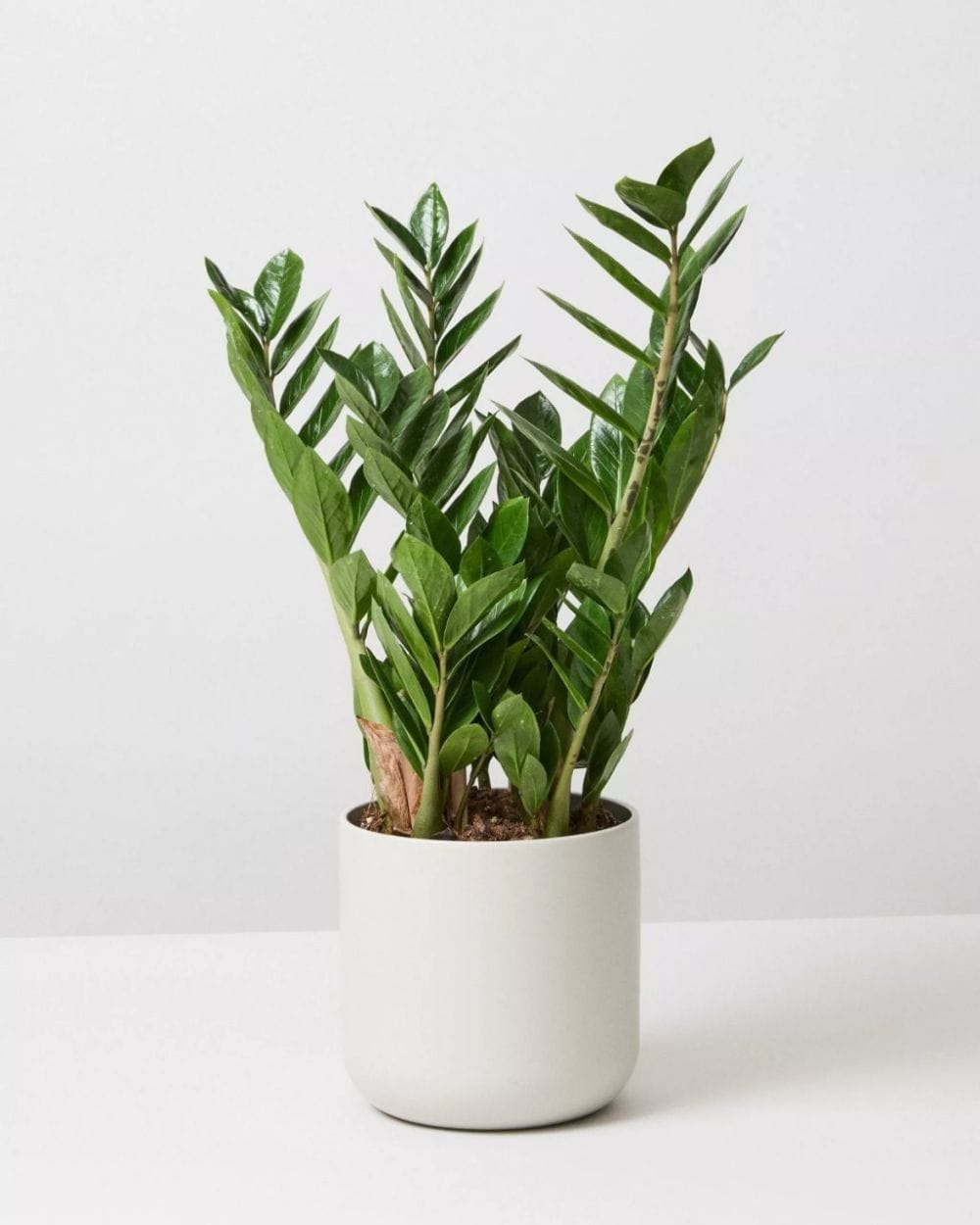
The ZZ Plant, Zamioculcas zamiifolia, is the indoor plant for people who travel, forget, work long hours, or have failed at every other indoor plant. It survives where almost nothing else does: dark corridor lobbies, AC-blasted offices, bedrooms with the blinds permanently shut. The leaves are waxy, glossy, deep green, and stay looking new for years.
The "large" ZZ is the same plant most people own as a desk-sized version, just grown for a few more years. A mature ZZ in a 12-inch pot at 70-90 cm tall has the visual weight of a small Dracaena, with a fraction of the fuss.
Varieties Worth Knowing
- Standard ZZ (Zamioculcas zamiifolia): glossy bright-green leaves on arching stems. The default. Grows the fastest of the three.
- Raven ZZ: new leaves emerge bright green, then darken to a near-black deep purple. Visually striking. Slower-growing than the standard, generally more expensive.
- Zenzi ZZ: compact, tightly-spaced leaves on shorter stems. Doesn't reach floor-plant size, peaks at 30-40 cm. Mention it here so you don't accidentally buy one expecting a tall plant.
For a floor-standing statement, choose Standard or Raven. Avoid Zenzi unless you specifically want the compact form.
Light
ZZ is famous for tolerating low light. This is partly true. It survives in low light. It thrives in bright indirect light.
- Bright indirect light from any window: ideal. Plant grows faster, new stems emerge regularly.
- Filtered sun (sheer curtain on south/east window): fine.
- Direct sun: avoid. The waxy leaves are not adapted to direct sun and will get washed-out or pale.
- Low light (interior corner, 3+ metres from window): survives indefinitely. Grows very slowly or not at all. New growth will be paler and weaker.
- Windowless room with only artificial light: survives for months but eventually declines. Rotate it to a brighter spot every few weeks for a "vacation."
Water: Less Than You Think
ZZ stores water in fat underground rhizomes that look like potatoes. The plant can survive months without water by drawing on this reserve. Overwatering is the only common way to kill it.
The rule: water deeply, then ignore for 2-4 weeks.
- March–June: every 14-18 days.
- July–September: every 25-30 days. The monsoon air keeps soil damp for ages.
- October–February: every 25-35 days. Almost dormant.
Yes, those are very long intervals. They are correct for ZZ. If in doubt, wait another week.
Lift the pot before watering. If it feels heavy, the rhizomes are still hydrated, skip. If it feels light, water deeply and let drain.
The Rhizome Economy
The underground rhizomes are the key to ZZ's reputation. They store water, store starch, and can regenerate the entire plant from a single chunk. This is why a ZZ left at an empty office over a 3-week holiday looks identical when you return.
What this means for care:
- The rhizomes need air. Tight, water-retentive soil suffocates them. Use a chunky mix.
- Rhizomes occasionally need space to expand, when stems are visibly crowded and the rhizomes are pushing against the pot wall, repot one size up.
- You can chop the rhizome network in half to propagate a new plant, both halves regrow.
Soil Mix
Fast-draining and gritty:
- 30% coco peat (see our coco peat formats guide)
- 30% potting soil or compost
- 30% perlite or coarse sand
- 10% small bark chips
Cactus or succulent mix from a garden centre, mixed half-and-half with regular potting soil, works perfectly.
Feeding
Light feeder. Balanced NPK at quarter strength every 8-10 weeks during March-October. See our NPK guide for context.
Or, simpler: one fertilizer stick per 8-inch pot, replaced just twice a year. The plant doesn't need more.
Propagation
Rhizome Division
Tip the plant out. You'll see fat tuber-like rhizomes with stems growing from them. Use a clean knife to cut between two rhizomes, keeping at least one full stem on each piece. Pot each piece separately. Don't water for a week.
Leaf Cuttings (Slow)
Pluck a healthy leaflet from a stem. Stick the base in moist potting mix in a small pot. In 3-6 months, a small rhizome forms underground. In another 3-6 months, a tiny new stem emerges. Slow but works.
Stem Cuttings in Water
Cut an entire stem at the base. Place the cut end in a glass of water. Change weekly. Rhizome forms in 8-12 weeks. Once a small rhizome is visible, plant in soil.
Common Problems
1. Yellow Stems Falling Over
Overwatering. The rhizome has rotted. Tip out, cut away any soft brown rhizome, let dry 48 hours, repot in dry mix. Don't water for 2 weeks. If more than half the rhizomes are gone, take a healthy stem cutting and start over.
2. Leaves Dropping From the Stems
Usually severe underwatering, the plant has finally emptied its reserves. A deep watering brings it back, though some bare stems are unavoidable. Don't be alarmed if you see leaflets fall off; the plant will replace them.
3. No New Growth for Months
Light is too low. Move closer to a window. Also possible if the plant is severely root/rhizome bound, check by tipping out.
4. Leggy Stems Falling Outward
Not enough light, plant stretching. New stems grow toward the window, then flop over. Move to brighter spot and rotate the pot every 2 weeks.
The Toxicity Question
You'll see warnings online that ZZ Plant is "highly toxic" or "poisonous to touch." This is overstated.
The truth: every part of the plant contains calcium oxalate crystals. If a child or pet chews a leaf, the crystals cause oral irritation, drooling, and possibly vomiting, uncomfortable but not lethal. Skin contact with the sap can cause irritation in sensitive people. Wash your hands after pruning or repotting.
Practical guidance:
- If you have a curious cat that chews leaves, choose a different plant.
- If you have a toddler at the leaf-tasting stage, put the plant out of reach.
- If you have older kids and pets that ignore plants, the ZZ is fine.
Where to Place It at Home
- Bedroom corner: tolerates dim morning light, doesn't need attention, looks furniture-like.
- Living-room beside a sofa: pairs well with a Snake Plant or Rubber Plant for layered greenery.
- Entrance lobby, lift landing, hallway: survives the low light that kills everything else.
- Home office: looks great in video-call backgrounds and doesn't care about AC.
- Office reception or meeting room: the unofficial plant of Indian co-working spaces, for good reason.
Avoid:
- Direct south or west sun behind glass.
- Decorative pots without drainage holes.
- Anywhere a pet or toddler can chew the leaves daily.
Bottom Line
The ZZ Plant is the closest thing to "plant as furniture" you can buy in India. Glossy, sculptural, tolerant of every kind of neglect except overwatering. Buy Standard or Raven for floor presence. Set a calendar reminder to water every 3-4 weeks. That's the whole care routine.