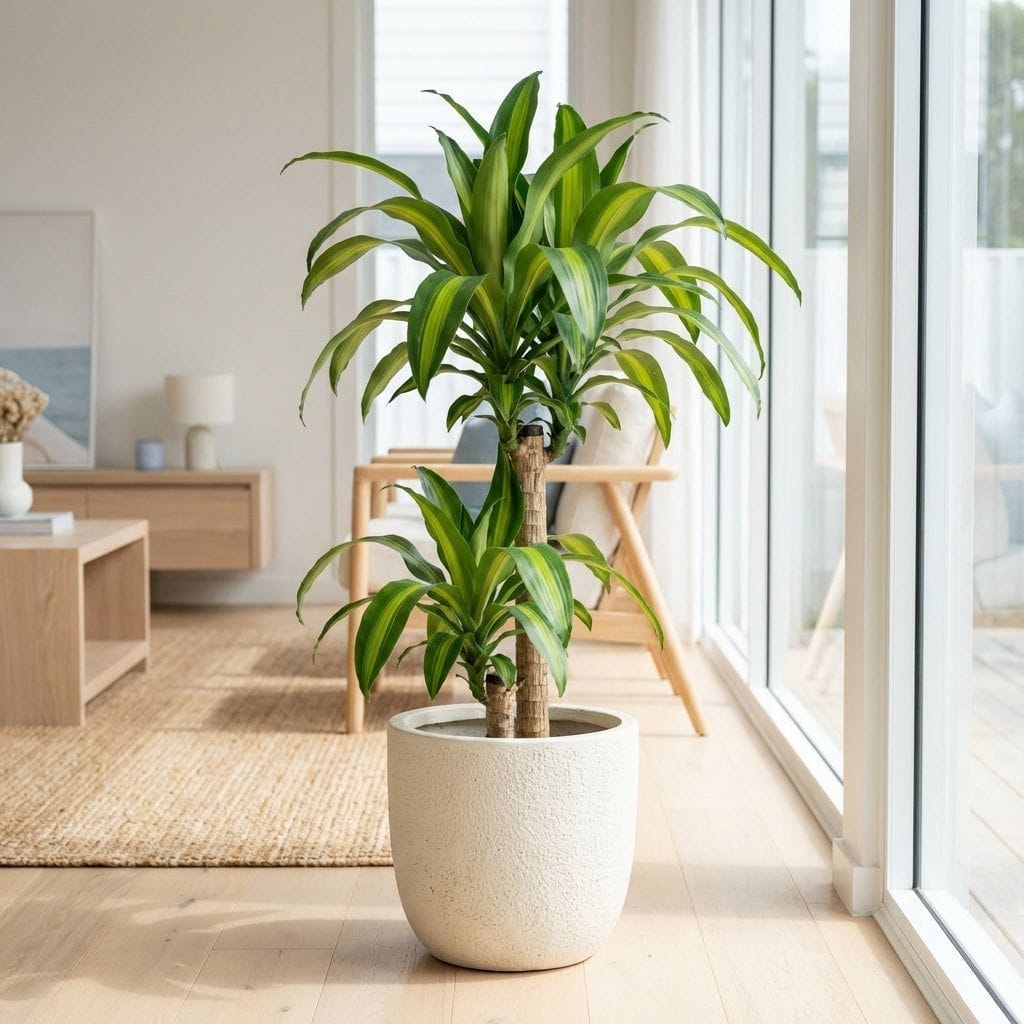
The Dracaena Massangeana (technically Dracaena Fragrans 'Massangeana') is sold as the Corn Plant for a reason. Long strappy leaves with a broad yellow-cream stripe down the centre, arching outward from a thick woody cane that looks exactly like a section of dried corn stalk. A mature Massangeana reaches 1.5-2 metres easily, has the visual presence of a small indoor tree, and asks for less attention than most plants of that size.
It's the lucky bamboo of large indoor plants in India: easy, available everywhere, hard to kill, and good for years of low-effort growth.
How Massangeana Is Sold
Nurseries usually sell Massangeana in one of two formats:
- Single cane with a leaf tuft on top: looks like a small tree. The cane was originally a section of stem that was rooted and grew its first leafy crown at the top.
- Three or five canes of different heights in one pot: the "staggered" look that's most popular. Each cane has its own leafy crown, creating a layered tropical canopy effect.
The staggered format is more dramatic in living rooms. The single cane works in tighter spaces. Care is identical for both.
Light
Massangeana is one of the more shade-tolerant large indoor plants. It survives in lower light than most Dracaenas, though it grows fastest in bright indirect conditions.
- Bright indirect light near an east or south window: ideal. New leaves come in with the strongest yellow stripe and the plant grows actively.
- Filtered south or west sun via sheer curtain: fine. Direct hot sun fades the yellow stripe and can scorch leaf edges.
- North window: works well in most Indian cities. The plant is happy here even if growth is slow.
- Medium-low light, 2-3 metres from a window: Massangeana copes with this better than almost any other large plant on this list. Growth slows but the plant stays healthy for years.
- Dark corner: the yellow stripe fades, leaves become smaller, but the plant survives surprisingly long.
Water
Like other Dracaenas, Massangeana prefers its soil on the dry side and rots quickly if kept wet. The thick cane stores some water reserve.
Stick a finger 2 inches into the soil. Dry? Water. Damp? Wait.
- March–June: every 7-10 days.
- July–September: every 14-18 days. Monsoon humidity slows everything.
- October–February: every 14-21 days.
Water deeply, drain fully, empty the saucer. Never let the pot sit in standing water.
Tap Water and Brown Tips
Massangeana shares the Dracaena family's tap-water sensitivity. Fluoride and chlorine in municipal tap water accumulate in the leaf tips, which turn brown and crispy.
Fix:
- Leave tap water in an open container for 24 hours before using. Chlorine evaporates and some fluoride settles.
- Better: use harvested rainwater during monsoon, or RO reject water.
- Flush the pot heavily every 2-3 months. Pour water through until it runs out the drainage hole for a full minute.
- Trim brown tips at an angle with sharp scissors, just inside the brown edge.
This is the same advice as for Dracaena Marginata. The whole genus is fluoride-sensitive, and tap water is the main reason their leaf tips brown.
Soil Mix
Standard well-draining mix:
- 35% coco peat (see our coco peat formats guide)
- 30% potting soil or compost
- 25% perlite or coarse sand
- 10% bark chips
Massangeana doesn't need frequent repotting. Every 2-3 years is plenty. It actually prefers being slightly root-bound.
Feeding
Light feeder. A balanced NPK at quarter to half strength every 6-8 weeks from March to October. See our NPK guide.
Fertilizer sticks work well. One stick per 10-inch pot, replaced every 8 weeks during the growing season.
Stop feeding entirely from November to February. Excess winter fertilizer just builds up as salt in the soil.
Why the Yellow Stripe Fades
The signature yellow-cream stripe down each leaf is what people buy Massangeana for. When new leaves come in mostly green, owners panic.
Three causes:
- Light too low (most common). Variegation is energy-expensive for the plant. In dim conditions, it produces all-green leaves that can photosynthesise more efficiently. Move closer to a window.
- Plant getting too much direct sun (less common). Hot direct sun bleaches the stripe and can also burn leaf edges. Filter with a sheer curtain or move back from the window.
- Plant is genuinely reverting. Rare but possible. Some variegated cultivars throw off all-green sections as they mature. If the whole new section of growth is green and the leaf shape looks slightly different too, you may have a reverted shoot. Cut it back to encourage the variegated growth points below.
Cane Propagation Trick
Massangeana propagates from cane cuttings the same way Yucca does. This is useful because you often end up with cuttings when you trim a top-heavy plant.
- Cut a healthy cane horizontally with a sharp knife or pruning saw.
- Mark the top end of each section if you cut more than one. Slanted top cut, flat bottom cut.
- Let cut ends air-dry for 2-3 days to callus.
- Insert the bottom end into a pot of well-draining mix, about a third of the cane buried. Or root in water if you want to watch the process.
- Roots in 4-8 weeks. New leaves emerge from the top in another 2-4 weeks.
You can also cut and re-root just the leafy top of a tall Massangeana, like a giant lucky bamboo cutting. The bare bottom cane will produce new shoots from below the cut.
Common Problems
1. Brown Leaf Tips
Tap water fluoride and chlorine, almost always. See the tap water section above for the fix.
2. Yellow Lower Leaves
Lowest leaf yellowing one at a time over weeks is normal aging. Cut it off cleanly at the cane.
Multiple leaves yellowing at once with damp soil is overwatering. Hold off water for 2-3 weeks. See our leaf diagnostic.
3. Soft Cane
Stem rot from too much water reaching the cane through wet soil. Cut away the soft section back to firm tissue. The remaining cane usually resprouts new growth.
4. White Cottony Patches at the Leaf Base
Mealybugs. They hide in the tight angle where the leaf meets the cane. Wipe off with cotton bud and 70% alcohol, follow with weekly neem oil sprays for 3 weeks.
Where to Place It at Home
- Living room near an east, south or north window: one of the most flexible large indoor plants for placement.
- Office reception, lobby, or hallway with daylight: tolerates AC well and looks intentional in commercial settings.
- Bedroom corner with morning light: the layered canes make a calm visual presence.
- Beside a sofa or armchair: a single-cane Massangeana acts like a small indoor tree without taking up much floor area.
- Stairwell with side daylight: vertical growth suits vertical space.
Avoid:
- Direct AC blast (brown leaf tips will increase).
- Direct hot summer sun without curtain (stripe fades, edges scorch).
- Pots without drainage holes.
- Homes where pets actively chew foliage.
Bottom Line
Dracaena Massangeana is the boring, reliable, low-effort large indoor plant most Indian homes overlook in favour of trendier options. It's still in every office lobby in the country for good reason. Tolerates a range of light, handles AC, propagates easily from cane cuttings, lives for a decade with minimal care. If you want a 6-foot plant without the Fiddle Leaf Fig drama, this is it.