Every flat in Bandra has one. Every co-working space in Bangalore has three. The Monstera Deliciosa is the most photographed houseplant in India and also the one people ask us about more than any other. The questions are always the same, why won't the leaves split, why is the new leaf yellow, why is the moss pole going mouldy in monsoon, is this even a Deliciosa or some other Monstera.
This is the complete care guide. Written for Indian homes, not for a heated apartment in Brooklyn.
Is This Actually a Deliciosa?
Before anything else, identify the plant. Nurseries in India sell at least four different plants under the "Monstera" label, and the care is not identical.
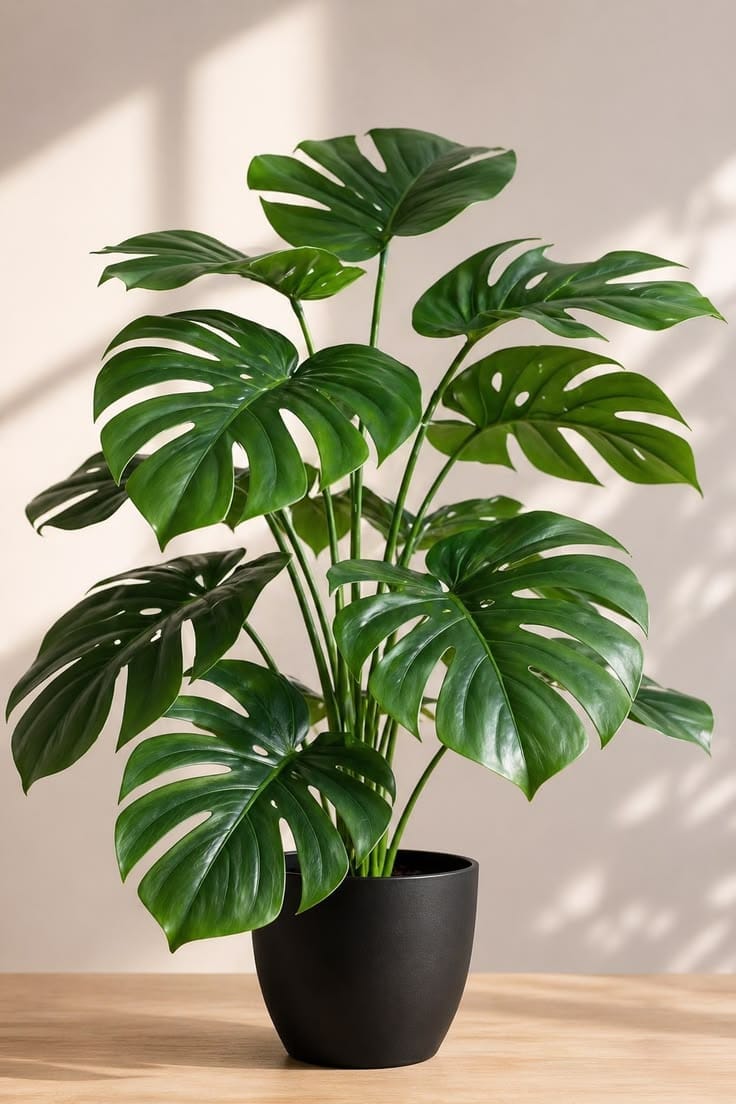
- Monstera Deliciosa: large heart-shaped leaves, deep splits and oval holes (fenestrations) as it matures, woody stem, eventually climbs.
- Monstera Adansonii (Swiss Cheese Vine): smaller, narrower leaves with holes from the start, trailing rather than climbing. Often sold mislabelled.
- Monstera Borsigiana: looks almost identical to Deliciosa but smaller, faster, leggier. Many nursery "Deliciosas" are actually Borsigiana.
- Philodendron Selloum/Xanadu: sometimes sold as "Monstera" because the leaves look similar. Different genus entirely.
For Deliciosa specifically: turn a leaf over. If the petiole (the stem joining the leaf to the trunk) has a distinct ridge or "geniculum" near the leaf base, it's Deliciosa. If smooth, it's likely Borsigiana. This guide is for Deliciosa, but most of it applies to Borsigiana too.
Light: The Single Biggest Mistake
Monsteras want bright indirect light for most of the day. Not a dark corner. Not direct south-facing afternoon sun. The difference between a Monstera that fenestrates and one that doesn't is, nine times out of ten, light.
Practical placement for Indian homes:
- East-facing window: perfect. Two to three hours of soft morning sun, bright shade for the rest of the day.
- North-facing window: works in Bombay/Bangalore/Chennai where ambient light is high. Marginal in Delhi/Punjab winters.
- West-facing window: pull the plant back 3-4 feet from the glass. Direct 4pm sun through a Delhi window will scorch leaves in a single afternoon.
- South-facing window: use a sheer curtain. Otherwise treat like west.
- Interior room with no direct window: the plant will survive but never split.
Water: When and How Much
Monsteras are tropical but not bog plants. The roots want to be moist, then almost-dry, then moist again. They rot if kept wet.
The rule: stick your index finger 2 inches into the soil. If it comes out dry, water. If it comes out with soil sticking to it, wait.
In practice for Indian conditions:
- April–June (peak summer): water every 4-6 days. AC-cooled rooms slow this down; sunny balconies speed it up.
- July–September (monsoon): every 8-12 days. Soil takes much longer to dry. This is when most Monsteras die from overwatering.
- October–February (winter): every 10-14 days. North Indian winters drop indoor temperature and metabolic rate; the plant drinks less.
- March (early summer): every 6-8 days, ramping up.
Water deeply when you do water. Until it runs out the drainage hole. Then empty the saucer. Never let the pot stand in water.
Why the Leaves Won't Split
This is the most common Monstera question we get. New leaves keep emerging as smooth, glossy ovals, no splits, no holes. People panic.
Three causes, in order of likelihood:
- Not enough light. Fenestration is an adaptation to break wind in the canopy and let light through to lower leaves. If a plant can capture all the light it needs with a solid leaf, it doesn't bother making the holes. Move it closer to a window. New leaves will start splitting within 2-3 new leaves.
- The plant is too young. Juvenile Monsteras don't fenestrate even in perfect light. The first 3-5 leaves are always solid. Be patient. By the time the plant has 8-10 mature leaves and a discernible trunk, splits should start.
- No support to climb. Monsteras in the wild climb trees. As they climb, leaves get bigger and more fenestrated. A Monstera lying on the ground or in a hanging basket stays juvenile longer. Add a moss pole or coir pole.
The Moss Pole: Yes, But Done Right
Yes, your Monstera wants a moss pole. No, the dry coir pole most nurseries sell is not the same thing.
A proper moss pole is wrapped in damp sphagnum moss that the plant's aerial roots can grow into. The pole feeds the plant through these aerial roots in addition to the soil roots. This is what triggers larger, more split leaves.
The trick in India: moss poles must stay damp. In Bangalore monsoon, they grow fungus. In Delhi summer with AC running, they dry out in a day. Spray the pole with water every 2-3 days. In peak summer, daily. In monsoon, watch for mould and let it dry between sprays.
A cheap alternative: a thick wooden stake wrapped in coconut coir. Less effective than sphagnum but won't go mouldy.
Soil Mix: Aerated, Not Garden Soil
This is where most Indian Monstera buyers go wrong on day one. The nursery sends the plant in heavy, water-retentive soil, fine for outdoor potted plants in Pune monsoon, terrible for an indoor Monstera in a non-draining pot.
Repot within a month of buying. Use this mix:
- 40% coco peat (drainage and water retention balance, see our coco peat format guide)
- 30% potting soil or aged compost
- 20% perlite or pumice (essential, this is the part most Indian nurseries leave out)
- 10% bark chips or shredded coir
The mix should feel chunky and light when you squeeze it. If it forms a tight ball, add more perlite.
Feeding: NPK and Cadence
Monsteras are heavy feeders during growth. Underfed Monsteras grow slowly and produce smaller leaves with less splitting.
Use a balanced NPK like 20-20-20 diluted to half strength, or a slightly nitrogen-leaning ratio like 24-8-16, Monsteras are leaf-first plants. See our NPK guide for what those numbers mean.
Easier alternative: a slow-release fertilizer stick pushed into the pot at the start of each growth phase. One stick per 8-inch pot, replaced every 6 weeks during March–October. Skip November–February, the plant is barely growing.
The Three Most Common Problems
1. Yellow Leaves
Almost always overwatering. The soil stayed wet too long, roots started suffocating, leaves yellowed from the bottom. Reduce watering frequency, check the pot has working drainage, ease off until soil dries 2 inches down between waterings. Full diagnostic here.
2. Brown Crispy Leaf Edges
Low humidity, which in Indian homes means AC. The plant is losing water faster than the roots can supply. Move it away from direct AC airflow. Group with other plants to create a humidity micro-climate. Don't bother misting the leaves, the moisture is gone in 20 minutes in a 22°C AC room.
3. Soft Mushy Stem Near Soil Line
Root rot. Stop watering immediately. Tip the plant out, inspect the roots, healthy roots are firm and white/tan, rotted ones are brown and mushy. Cut rotted roots off cleanly. Repot in fresh, dry, well-draining mix. Do not water for a week. If more than half the root mass is gone, take a top cutting and start over.
Propagation: Water Method That Actually Works
The Monstera is one of the easiest plants in the world to propagate. The most common Indian failure mode is cutting at the wrong place.
You need a node: the joint on the stem where a leaf and an aerial root come out. Cut about 2 cm below a node. The cutting must have at least one full leaf and the node. Stick the node end in a glass of water (room temperature, tap water that has sat overnight to let chlorine dissipate).
Keep the glass in bright indirect light. Change the water every 4-5 days. First white roots appear in 2-3 weeks. Wait until roots are 8-10 cm long before potting up, too early and the plant sulks for months.
Once potted, water more frequently than usual for the first 3-4 weeks. The plant is transitioning from water-fed to soil-fed roots and is briefly vulnerable.
Where to Place It at Home
The best Monstera spots in an Indian flat:
- Living-room corner near an east or south window, set back from the glass with a sheer curtain, the classic Pinterest shot.
- Open-plan kitchen-living junction: light from both sides, good airflow, plant becomes a visual divider.
- Beside a study or work desk within a metre of a window, the leaves react visibly to the morning light, the plant rewards attention.
Avoid:
- Bathroom, almost always too dark, despite the humidity argument.
- Direct AC blast zone, the leaves shrivel within weeks.
- Under a ceiling fan that runs all night, the constant air movement dries leaves faster than the roots can keep up.
Bottom Line
Monstera Deliciosa is genuinely easy compared to a Fiddle Leaf Fig or an Alocasia. Get the light right, get the watering rhythm right, give it something to climb, and it will reward you with the iconic split leaves within a year. Most "dying" Monsteras in Indian homes are not dying, they're underlit, overwatered, or in the original nursery soil. Fix those three things and the plant will outlive your sofa.