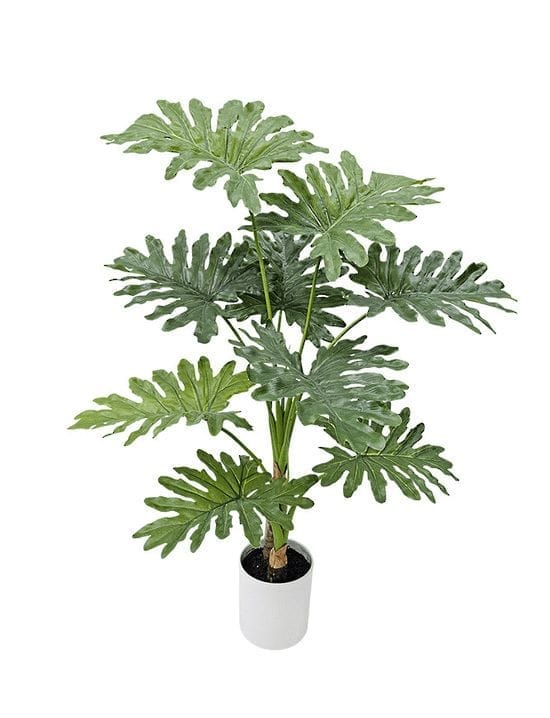
The split-leaf philodendrons sold as Selloum and Xanadu are some of the most rewarding tropical plants you can keep in an Indian home. Big, deeply lobed leaves on long stalks, mounding outward into a generous clump that fills a corner without needing climbing support. They love Indian humidity, tolerate AC reasonably well, and ask for almost nothing in winter.
The confusing part is that "Selloum," "Xanadu," and the more recent "Hope" are sometimes sold interchangeably, even though they grow very differently.
Which One Do You Actually Have?
- Philodendron Selloum (Thaumatophyllum bipinnatifidum): large plant, leaves up to 60-80 cm long, deeply lobed, eventually forms a trunk-like stem as old leaves drop. Can reach 1.5-2 metres across in a mature pot.
- Philodendron Xanadu (Thaumatophyllum xanadu): compact cousin, leaves 20-40 cm, lobed but less dramatic, mounds outward at about waist height. Stays bushy and never really climbs.
- Philodendron Hope (a Selloum hybrid): in between the two. Smaller than full Selloum, larger and more cut than Xanadu, behaves like a younger Selloum for years before showing its mature size.
For most Indian homes, Xanadu is the safer choice. It stays compact enough to live in a smallish living room indefinitely. Selloum is spectacular if you have the floor space and ceiling height to host a plant that wants to be the size of an armchair.
This guide covers all three. The care is essentially the same; the main differences are size and how much room you need to give the plant to spread.
Light
These philodendrons want bright, indirect light. They evolved as understory plants in tropical forests, so they get filtered light, not direct sun.
- East or north-east window: ideal. Morning sun is gentle enough that the leaves don't scorch.
- South or west window with a sheer curtain: works well. Direct hot afternoon sun bleaches the leaves and the curtain prevents that.
- North window in Bangalore, Mumbai, Chennai: enough ambient light. North window in Delhi or Punjab winters can be marginal; the plant slows down but survives.
- Bathroom skylight or stairwell with daylight: surprisingly good, especially for Xanadu. The humidity bonus matters.
- Dark corner: leaves stretch toward the light, the clump loses its tight shape, new leaves come in smaller.
Water
Philodendrons want their soil consistently moist but never waterlogged. They're thirstier than a Rubber Plant or a ZZ, less thirsty than a Calathea.
Stick a finger 2 inches into the soil. Slightly damp? Wait. Surface dry? Water.
- March–June: every 5-7 days.
- July–September: every 7-10 days. Even with monsoon humidity, these plants drink more than most.
- October–February: every 10-14 days.
Water deeply, let drain, empty the saucer. The roots will rot if kept submerged.
Why Monsoon Is the Best Season for Your Philodendron
Most tropical houseplants in India have a love-hate relationship with monsoon. Philodendrons fall firmly on the love side. Three reasons:
- The high ambient humidity matches what these plants want naturally. Leaves stay tender and lush.
- The diffuse, overcast light is essentially perfect filtered tropical light.
- Warm but not blistering temperatures (28-32°C) are the prime growth zone.
If you want to push growth, monsoon is the time. Feed regularly, water on schedule, watch the plant produce new leaves at twice the rate of any other season.
Soil Mix
Rich, water-retentive, but well-aerated. Philodendrons have thick fleshy roots that want both moisture access and air pockets.
- 35% coco peat (see our coco peat formats guide)
- 30% compost or rich potting soil
- 20% perlite or coarse sand
- 10% bark chips or shredded coir
- 5% well-rotted cow manure or vermicompost
Repot every 2-3 years, or when roots are clearly emerging from the drainage holes. Go up one pot size. Selloum especially appreciates pot upgrades; it has an aggressive root system.
Feeding
Heavy feeders during March to October. A balanced NPK (20-20-20) at half strength every 3 weeks, or slightly nitrogen-leaning (like 24-8-16) if you want to push leaf size. See our NPK guide for what those numbers mean.
Slow-release fertilizer sticks work well. One stick per 8-inch pot, two per larger pots, replaced every 6 weeks in the growing season.
Skip feeding November to February. The plant is barely growing and excess fertilizer just builds up as soil salts.
Stake or Let It Mound?
Selloum eventually forms a thick woody trunk as the lower leaves drop and only the upper rosette stays leafy. Some owners stake the trunk upright for a tree-like silhouette. Others let it sprawl naturally.
Natural sprawl pros: the plant looks lush, dense, and full. The mound shape works well in corners and against walls.
Staked trunk pros: more architectural, takes up less floor area, easier to underplant or place a smaller plant next to.
For Xanadu, no staking is needed or possible. It mounds naturally and stays under a metre tall.
If you want to stake a Selloum: insert a thick bamboo cane next to the trunk and tie loosely with soft fabric ties. Replace ties every few months as the trunk thickens.
Common Problems
1. Yellow Leaves
If it's the lowest leaf at the edge of the clump and it's a single leaf at a time, that's normal aging. Cut it off at the base.
If multiple leaves yellow at once and the soil feels wet, that's overwatering. Hold off water for a week, check soil drainage, repot if it stays soggy. See our leaf diagnostic.
2. Pale Leaves With Green Veins
Iron deficiency, usually from soil being too alkaline. Try a chelated iron supplement, or repot with a fresh slightly-acidic mix. Coco peat in the new mix helps lower pH.
3. Long Stretched Petioles, Sparse Leaves
Light too low. The plant is reaching for whatever brightness it can find. Move closer to a window. Trim the worst stretched leaves to encourage compact new growth.
4. Brown Crispy Leaf Edges
Low humidity or tap-water salts. Group with other plants to create a humidity micro-climate. Use settled water for a few weeks and flush the pot heavily once.
Propagation
Selloum propagates from stem cuttings or by division. Xanadu is harder because it doesn't form an obvious climbing stem; division is the only realistic method.
For Selloum stem cuttings:
- Identify a section of stem with at least one node (the joint where a leaf or aerial root emerges).
- Cut 2 cm below the node with a clean knife.
- Place in water or moist perlite. Roots in 3-6 weeks.
- Pot up once roots are 5-7 cm long.
For both species, division is the more reliable method:
- Tip the plant out of the pot during repotting.
- Find a natural separation point in the clump where two stems share a root system.
- Cut between them with a sharp knife, keeping a substantial root mass with each section.
- Pot each section separately. Water lightly for the first two weeks while the cut surfaces heal.
Where to Place It at Home
- Living-room corner near an east or south window: Selloum loves the spread; Xanadu fills a smaller corner neatly.
- Balcony with a roof: peninsular India year-round; North India during monsoon and shoulder seasons.
- Bathroom with daylight: Xanadu especially thrives in the warm-humid bathroom environment, provided there's at least some natural light.
- Beside a sofa or media unit: Xanadu makes an excellent low-mounding accent plant.
- Stairwell or hallway with side light: the dense leaf clump fills space without dominating.
Avoid:
- Direct AC blast (brown edges).
- Cramped corners where Selloum can't fan out to its mature spread.
- Homes with pets that chew foliage.
Bottom Line
If you have the space, Selloum is the more dramatic plant and rewards you with a tropical jungle feel by year three. If you want the look in a tighter footprint, Xanadu gives you 80% of the visual impact in 40% of the space. Both are easier than a Fiddle Leaf Fig and more rewarding than a Snake Plant. Monsoon will be the season your philodendron remembers you for.