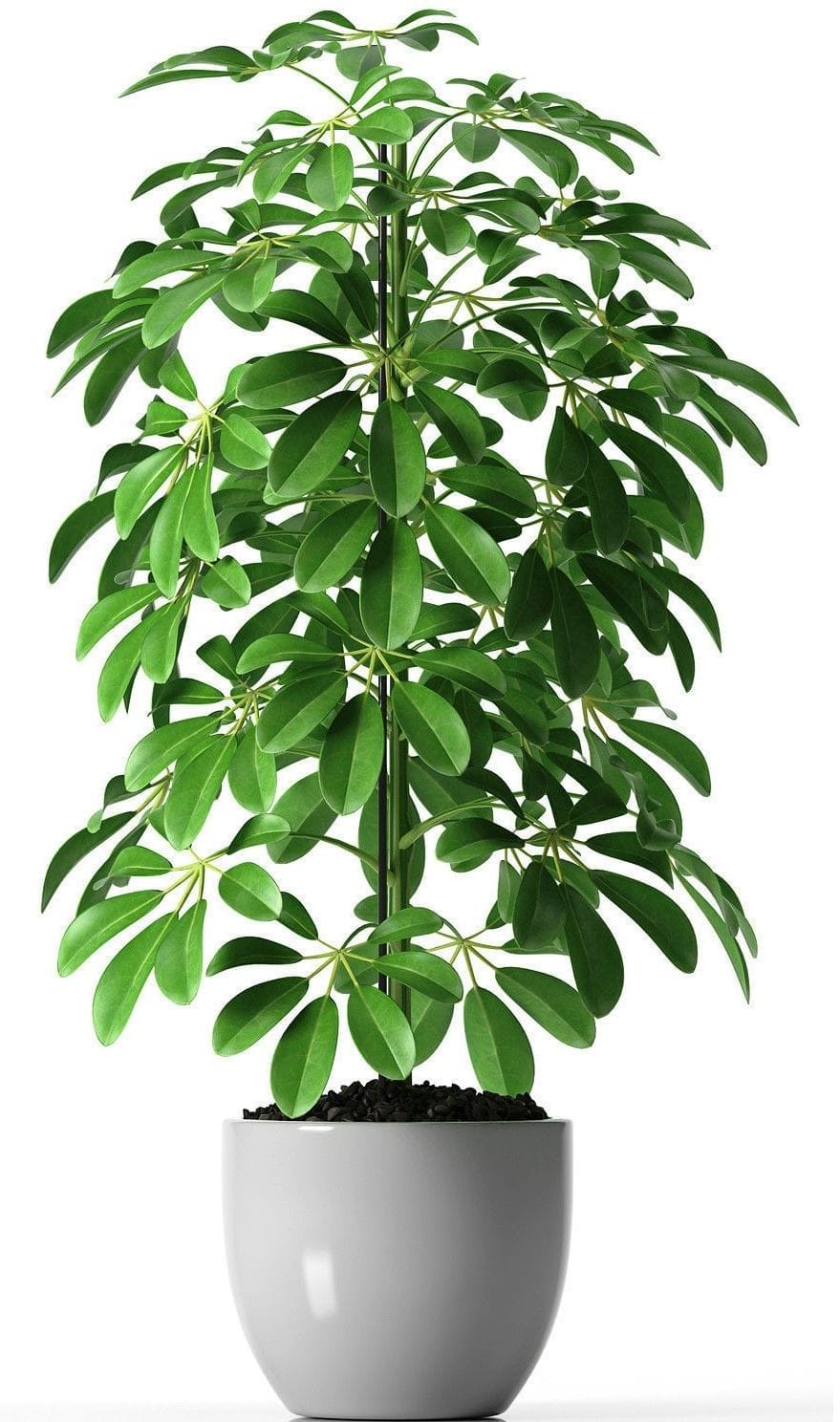
The Schefflera, called Umbrella Plant in most Indian nurseries, looks like its common name suggests. Glossy leaflets fanning out from a single stem like the spokes of an umbrella. Grows fast, tolerates a wide range of conditions, and reaches a substantial floor-plant size within a few years. If you want a green corner-filler that responds to pruning and rewards even moderate care, this is one of the easiest options on the market in India.
Two species are commonly sold, and the difference matters more for placement than for care.
Actinophylla vs Arboricola
- Schefflera Actinophylla (Australian Umbrella Tree): large leaflets, can reach 2-3 metres indoors over a decade, single tall trunk with umbrella-like canopies along its length. The "big" Schefflera.
- Schefflera Arboricola (Dwarf Umbrella Plant): smaller leaflets, denser bushy growth, peaks at about 1.5 metres. The variety most often sold as a "table plant" or "small floor plant" in India.
Within Arboricola, there are also variegated forms with cream or yellow splashes on the leaves (often labelled "Schefflera Gold Capella" or just "Variegated Schefflera"). Care is identical to the plain green form, but variegated plants need brighter light to keep their colouring.
For a first Schefflera, get plain green Arboricola. It's the most forgiving and fits most living rooms.
Light
Schefflera tolerates a wide range of light. It's one of the few large indoor plants in India that copes genuinely well with medium light, though it always prefers brighter.
- Bright indirect light from an east or south window: ideal. The plant grows fastest and stays compact.
- Filtered sun via sheer curtain: fine. The leaves may lighten slightly in peak summer but rebound.
- North window: works in most Indian cities. Growth slows but the plant stays healthy.
- Medium light, 2-3 metres from a window: plain green Arboricola handles this. The plant stretches a bit and may need pinch-pruning.
- Dark corner: variegated forms lose colour; all forms go leggy with weak stretched stems.
Water
Schefflera prefers consistent moisture without sitting wet. Roughly similar to a Rubber Plant in water needs.
Stick a finger 2 inches into the soil. Dry? Water. Damp? Wait.
- March–June: every 5-7 days.
- July–September: every 10-14 days.
- October–February: every 12-16 days.
Water deeply, let drain, empty the saucer. Schefflera is more forgiving than most about occasional underwatering; it droops dramatically and recovers within a day of a deep drink. Overwatering is what kills them.
Why Yours Goes Leggy and How to Fix It
The most common Schefflera complaint: the plant has grown tall and bare, with leaves only at the top, like a sad lollipop.
Cause: light too low. The plant stretches toward whatever light source it can find and abandons the leaves it can't afford to feed.
Two-step fix:
- Move the plant to brighter light. This stops the stretching.
- Pinch out the growth tip (the topmost cluster of new leaves) with your fingers or sharp scissors. This forces the plant to push out two or three side branches from below the cut.
You can repeat this pinch-pruning on the new side branches once they're 15-20 cm long. Each pinch doubles the branch count. Within a season, a leggy lollipop becomes a dense bushy plant.
Soil Mix
Standard well-draining mix:
- 35% coco peat (see our coco peat formats guide)
- 30% potting soil or compost
- 25% perlite or coarse sand
- 10% bark chips
Repot every 2-3 years, in spring (March-April). Schefflera is a vigorous grower and can become root-bound surprisingly quickly. If you see roots coming out of drainage holes or the plant drying out within 2-3 days of watering, time to repot.
Feeding
A balanced NPK at half strength every 3 weeks during March-October. See our NPK guide.
Or one fertilizer stick per 8-inch pot, replaced every 6 weeks during the growing season.
Schefflera is a moderate feeder. Overfeeding produces lush but weak growth that flops over. Stick to half-strength doses.
Pinch-Pruning for a Fuller Crown
This is the Schefflera superpower most owners never use. The plant responds to tip pruning by producing multiple side shoots, which makes it the easiest large indoor plant to shape.
How to do it:
- Identify the topmost growth cluster of any main stem.
- Pinch the very top off with your fingers, or snip just above the most recent set of leaves.
- Within 3-6 weeks, two or three new shoots emerge from below the cut.
- Repeat on each new shoot once it reaches 15-20 cm.
Best done in spring (March-May) when growth is strongest. The plant heals quickly and the new shoots come in faster.
Common Problems
1. Leaves Yellowing and Dropping
If lower leaves only, one at a time, that's normal aging. Cut at the base.
If multiple leaves yellow and drop at once with damp soil, it's overwatering. Stop watering for 2 weeks. Check soil drainage and root health.
If leaves drop quickly with mostly green leaves on the floor, it's shock from a recent move, sudden temperature change, or AC blast. Schefflera dislikes change but recovers within a few weeks if conditions stabilise. See our leaf diagnostic.
2. Long Bare Stems
Light too low. Move closer to a window and pinch-prune as described above.
3. Scale or Mealybugs
Schefflera is susceptible to both. Watch for sticky leaves (the giveaway for scale) or white cottony patches (mealybugs). Weekly neem oil sprays for 3-4 weeks fix both.
4. Spider Mites in AC Rooms
Tiny pale specks on the leaves with fine webbing on the undersides. Treat with the same neem oil routine. Improve humidity by grouping plants and moving away from direct AC airflow.
Propagation
Schefflera roots from stem cuttings.
- Cut a 15-20 cm stem section, just below a node.
- Remove the lower leaves, keeping the top 3-4 leaflet clusters.
- Dip the cut end in rooting hormone (helpful but not essential).
- Pot in moist coco peat with perlite, or root in a glass of water.
- Roots in 4-8 weeks. Once established, pot up in standard mix.
Spring cuttings root fastest. Winter cuttings often fail.
Air-layering also works for thicker stems and is more reliable. Same technique as for a Rubber Plant (see our rubber plant guide for the steps).
Where to Place It at Home
- Living-room corner near any window: Schefflera is one of the most flexible large plants in terms of placement.
- Beside a sofa or armchair: the umbrella canopies pair well with seating.
- Office reception or meeting room: tolerates fluorescent supplementary light and AC.
- Stairwell with vertical light: tall Arboricola or Actinophylla fits the geometry.
- Bedroom corner with morning light: a smaller specimen makes a calm presence.
Avoid:
- Direct AC blast zones.
- Tight low-ceiling corners where the canopy hits the ceiling.
- Areas accessible to pets that chew foliage.
Bottom Line
Schefflera is the indoor plant for people who want a large green presence and the ability to shape it. Light-flexible, water-forgiving, pinch-pruning friendly. Plain green Arboricola is the most reliable; variegated forms need a bright window. Pinch-prune in spring to build a full crown, watch for sticky leaves as the early sign of scale, and you have a plant that fills a corner for a decade.